
A Simple Daily Guide for Better Movement, Breathing & Recovery
Modern life places enormous demands on the human body.
Long hours sitting, stress, repetitive movement, poor sleep, limited walking, and constant screen use often contribute to:
- Neck tension
- Tight hips
- Lower back stiffness
- Shallow breathing
- Reduced mobility
- Fatigue
- Postural strain
The good news is that small consistent habits can create meaningful long-term change.
This guide provides five simple daily mobility practices designed to:
- Improve movement quality
- Reduce muscular tension
- Support better posture
- Improve breathing mechanics
- Increase body awareness
- Help regulate the nervous system
You do not need expensive equipment or long workouts.
Consistency matters more than intensity.
HABIT 1
TAKE MOVEMENT BREAKS EVERY HOUR
WHY IT MATTERS
The body adapts to whatever position it spends the most time in.
Long periods of sitting may contribute to:
- Hip stiffness
- Thoracic tightness
- Reduced circulation
- Neck tension
- Lower back discomfort
- Reduced rib mobility
The problem is not sitting itself.
The problem is staying in one position for too long.
DAILY PRACTICE
Every 45–60 minutes:
- Stand up
- Walk briefly
- Reach overhead
- Rotate gently side to side
- Roll the shoulders
- Take 5 slow breaths
Even 1–2 minutes of movement helps.
QUICK RESET SEQUENCE
Try this simple reset:
- Stand tall
- Reach both arms overhead
- Rotate slowly left and right
- Take 5 slow nasal breaths
- Walk for 1 minute
This encourages circulation, mobility, and nervous system regulation.
HABIT 2
WALK EVERY DAY
WHY IT MATTERS
Walking is one of the most natural corrective movement tools available.
Walking supports:
- Hip mobility
- Spinal rotation
- Balance
- Circulation
- Stress reduction
- Nervous system regulation
- Posture awareness
The body was designed to move regularly.
DAILY PRACTICE
Aim for:
- 20–40 minutes of walking daily
OR - Several shorter walks throughout the day
Walking outdoors may further improve:
- Mood
- Stress regulation
- Mental clarity
- Recovery
WALKING TIPS
While walking:
- Relax the shoulders
- Swing the arms naturally
- Breathe through the nose when possible
- Allow gentle torso rotation
- Avoid excessive tension
Walking should feel rhythmic and relaxed.
HABIT 3
IMPROVE YOUR BREATHING AWARENESS
WHY IT MATTERS
Breathing directly affects:
- Posture
- Muscle tension
- Stress levels
- Core stability
- Nervous system regulation
Many people unknowingly develop shallow upper-chest breathing patterns during stress.
This often increases:
- Neck tension
- Jaw clenching
- Shoulder tightness
- Fatigue
DAILY PRACTICE
Spend 3–5 minutes practicing slow breathing.
Try this:
- Sit or lie comfortably
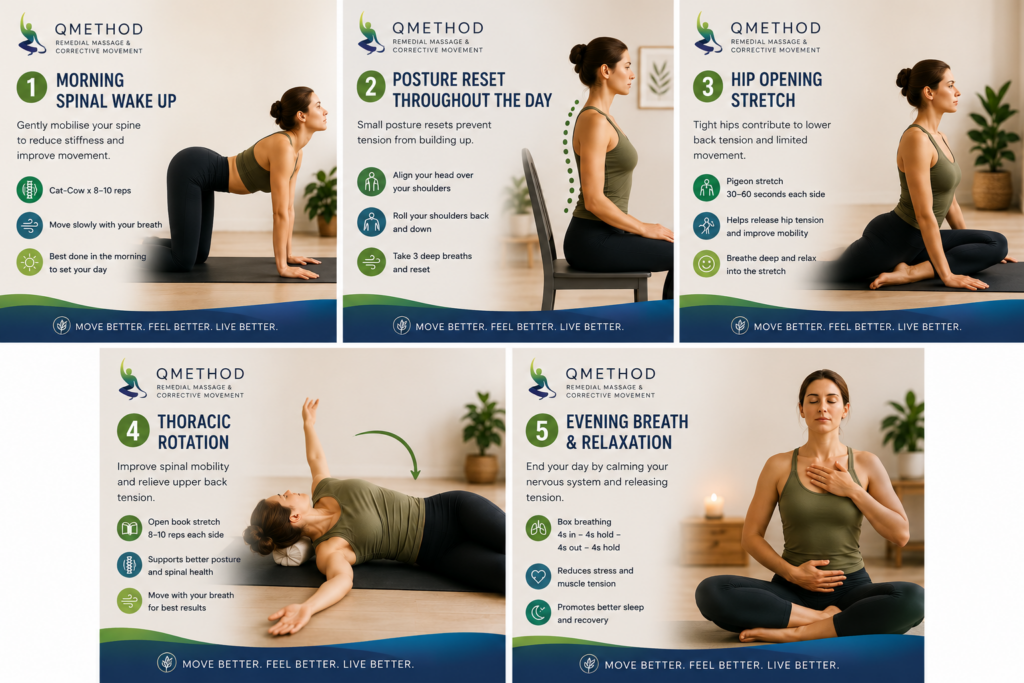
- Place hands around the lower ribs
- Inhale slowly through the nose
- Feel the ribs expand sideways
- Exhale slowly without force
- Relax unnecessary tension
The goal is calm, controlled breathing—not forcing large breaths.
BREATHING REMINDERS
Helpful cues:
- Relax the jaw
- Soften the shoulders
- Avoid shrugging during inhalation
- Let the abdomen move naturally
- Slow the exhale slightly
Small breathing changes may create noticeable reductions in tension.
HABIT 4
TRAIN MOBILITY WITH CONTROL
WHY IT MATTERS
Mobility is not just stretching.
True mobility involves:
- Strength
- Control
- Coordination
- Stability
- Awareness
The nervous system feels safer when movement is controlled.
Aggressive stretching alone is often less effective than slow controlled movement.
DAILY PRACTICE
Choose 2–3 mobility exercises daily.
Focus on:
- Slow movement
- Smooth breathing
- Gentle control
- Quality over intensity
Areas that often benefit include:
- Hips
- Thoracic spine
- Ankles
- Rib cage
- Shoulders
SIMPLE MOBILITY FLOW
Try this sequence:
- Cat-cow spinal movement
- Thoracic rotations
- Hip mobility circles
- Deep squat hold
- Controlled reaching patterns
Move slowly and avoid forcing range.
HABIT 5
REDUCE UNNECESSARY MUSCLE TENSION
WHY IT MATTERS
Many people carry tension unconsciously throughout the day.
Common areas include:
- Jaw
- Neck
- Shoulders
- Lower back
- Hands
- Hips
Stress and mental overload often increase muscular guarding.
Awareness is the first step toward change.
DAILY PRACTICE
Several times per day, pause and ask:
“Where am I holding unnecessary tension?”
Then:
- Relax the jaw
- Drop the shoulders
- Unclench the hands
- Slow the breath
- Soften the abdomen
Small awareness resets help retrain the nervous system.
THE POWER OF RECOVERY
Tension reduction is not only physical.
Recovery habits matter.
Helpful strategies include:
- Quality sleep
- Walking outdoors
- Slow breathing
- Relaxation practices
- Movement variability
- Reducing overstimulation
The body functions best when stress and recovery are balanced.
DAILY MOBILITY CHECKLIST
MORNING
☐ Gentle mobility practice
☐ Slow breathing
☐ Short walk or movement
DURING THE DAY
☐ Movement breaks every hour
☐ Relax jaw and shoulders
☐ Practice Breath Awareness
☐ Walk regularly
EVENING
☐ Light mobility work
☐ Reduce screen tension
☐ Slow breathing practice
☐ Recovery and relaxation
FINAL THOUGHTS
Reducing tension is not about forcing the body.
It is about improving:
- Awareness
- Movement quality
- Breathing
- Recovery
- Nervous system regulation
- Consistency
Small daily habits create long-term adaptation.
The goal is not perfection.
The goal is building a body that moves more efficiently, breathes more comfortably, and adapts more effectively to daily life.
ABOUT QMETHOD
QMETHOD integrates:
- Remedial massage
- Corrective movement
- Breathwork
- Mobility training
- Nervous system education
- Functional movement strategies
The goal is long-term resilience, movement quality, and sustainable wellbeing.
NEXT STEP
Book a posture and movement assessment to discover the habits contributing to tension and movement restriction.
Move Better • Feel Better • Live Better